I was wondering if anyone out there hs used a 24v battery powered offset drill motor to raise their center board. I know they make a fitting to fit the wench and many use this on raising sails. Was wondering if it would work on the “Motherboard”?
While I have your attention, what are the fixtures attatched to the fwd bulkhesd in main saloon in the freedom? There is another on the aftbulkhead above the seats . They look like they hold a pipe, maybe 2" in dia. Thanks Numbknots
The fixtures are for a pipe holding lee cloth – to create a birth while at sea.
I have no opinion on electric winches, except that centerboard on F28 is one heavy thing.
I had a Freedom 33 CB, but can’t imagine a batterypowered drill that would be able to lift the board. It weighs about 1000 lbs and took me 80 turns on the winch (type halyard winch with wire on drum) to lift it. I always needed to stop halfway to take a breath.
Yeah 80’s about right, we must be about the same age. I’m going to try one of those 24v drill motors and let the world know the results. Numbknots
I would recommend the Milwaukee hole hog 90 degree drill motor. It’s 28 volts. It’s got plenty of torque and I’ll bet it will do the job. I recently cruised on a boat with a manual windlass and ever time I stroked that darn lever I watched a little hex head bolt down on the gear body turning and wished I had my drill with me! I have the only centerboard Freedom I’ve heard of that came with an electric winch built it from the factory. I can tell from paint, fiberglass, etc… that it was there when the boat was commissioned. I also have the only metal core centerboard I know of although someone who worked there told me that it did happen so at least I’m not crazy. Cordless Drill I took first google so you can look around for a better price for sure.
George
hi when i bought kusi the surveyor recommended i checked the lifting gear since he couldn’t check it as part of the survey.
when i did i found that the double and becket block on the centreboard was badly distorted made of tuffnol and very worn so i researched a replacement. since it had failed under load
i couldn’t go like for like so i worked out the strength of the loop on the centreboard (10 mm stainless 3 - 5 tons )and the sheaves at the other side, on the front of the case(3*1.6 tons.) and of course the line(10mm dyneema 5 parts= 15 tons). this revealed that the weak link was the block , by quite a margin. i soon found nobody sells double and becket blocks of about 4 ton break load in the uk i could pay an arm and a leg for a shaeffer block a ali black magic harken 75 mm with balls and rollers or…
two harken stainless 75 esp blocks bolted together ( 3.1 ton each thus combined breaking load 6.2 tons) as that was the only way i could get a plain bearing block , double and becket in stainless not aluminium, strong enough.
it felt like sacrilege putting two fine hand polished and expensive blocks in the case but the only other way to get the strength was aluminium roller and ball blocks. below the waterline and hard to get at is no place for ali racing blocks. i might check them but future owners wouldn’t know what they were.
while i was at it i found the turning block at deck level was pulling through the deck and the sheave didnt turn. i filled the deck with epoxy filler mix and put a big thin ss backplate under the deck and changed the sheave for a harken hi load sheave a 727 i think which was an exact replacement and it has side load balls and a teflon bush. the fairlead on deck i replaced with a harken roller block (part 1963 ) i picked up cheap
thus you can raise the board with one hand, before it took two.
also i can sleep better knowing it is unlikely to break.
it pays to reduce friction as much as possible im only 55 kilos 9.5 stone so i love harken blocks!!
and i have made kusi easier to sail purely by making things run freely.
powered winches sound good too , but better sheaves will make it more likely to work and save battery power
phil kusi f 35 ck
The fixtures are for a pipe holding lee cloth – to create a birth while at sea
I think the pipe cot is a bit tight for creating a birth, but you can sleep there quite comfortably! 
On a more serious note, we replaced the centreboard pivot this spring, with a new nylon bush. The slow, hard part was removing the headlining to get at the nuts securing the deck sheave for the lifting pennant. The fork (see Phil Downey’s post for a drawing at the end of the manual) came out quite easily, as did the pivot pin: the bush was something else again. I put in a new stretched polyester 12mm pennant, although the similar but six year old line it replaced was still ok. Not so the double block and becket, with Delrin ball bearings. These had completely disintegrated, although the block claimed a SW of 1000kg, and the board’s all up weight is only 500kg. I found some German made tufnol type double blocks with a becket, which had been tested to 1500kg, and have used one as a replacement. The board moved much more easily after that, although I generally use the Lewmar power winch which was a major factor in buying the boat nine years ago.
Tragically, all this work was wasted when I hit a rock at 4 knots in Finland, splitting the CB moulding from pivot to tip. It bulged the sides out enough that the board could no longer be fully raised. Hopefully, the yard in Sweden will make everything good as new, although the £300 I paid for the pivot to be replaced in Shetland is likely to be ten times more in the Baltic. The centreboard case was undamaged by the collision, and the boat otherwise sound.
If anyone is interested, I have some photographs of the pivot, fork, and lifting tackle, should they be thinking of taking the board out.
Gerald, I always heard that bearing blocks are only useful for dynamic loads like sheets. For static loads like halyards and centerboard pennants one is supposed to use blocks with bushings to prevent the crushing of bearing balls. Evidently, that happened with you. I also used tufnol replacement blocks also because they are very seawater resistant. I did it in '97. The current owner still uses the blocks and the 5 mm Dyneema pennant I put in to replace the part rope, part wire pennant. I’d like to see some pics of the innards of the board and case, always wondered how that is constructed. Hopefully they can repair your board.
A few photos: the quality is not great, as many were taken with a mobile phone.
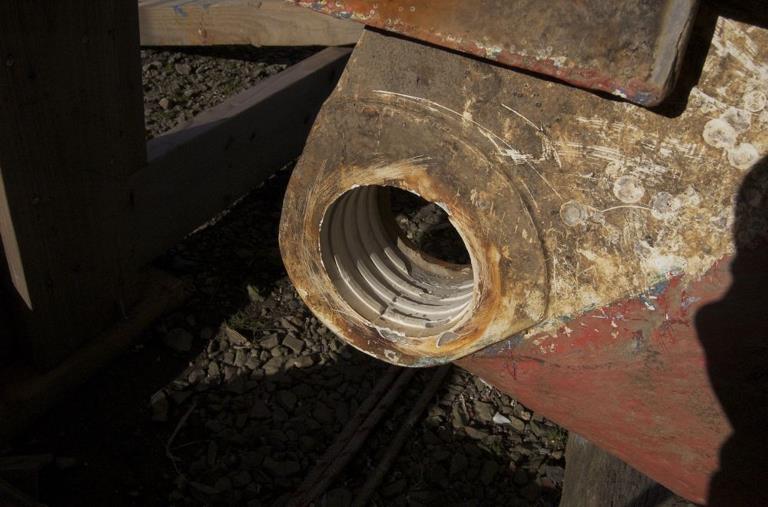
This is the pivot hole, with the lower end of the fork just visible.
The pivot needed the bush to be cut out, the moulding smoothed with a router, and a new bush made.
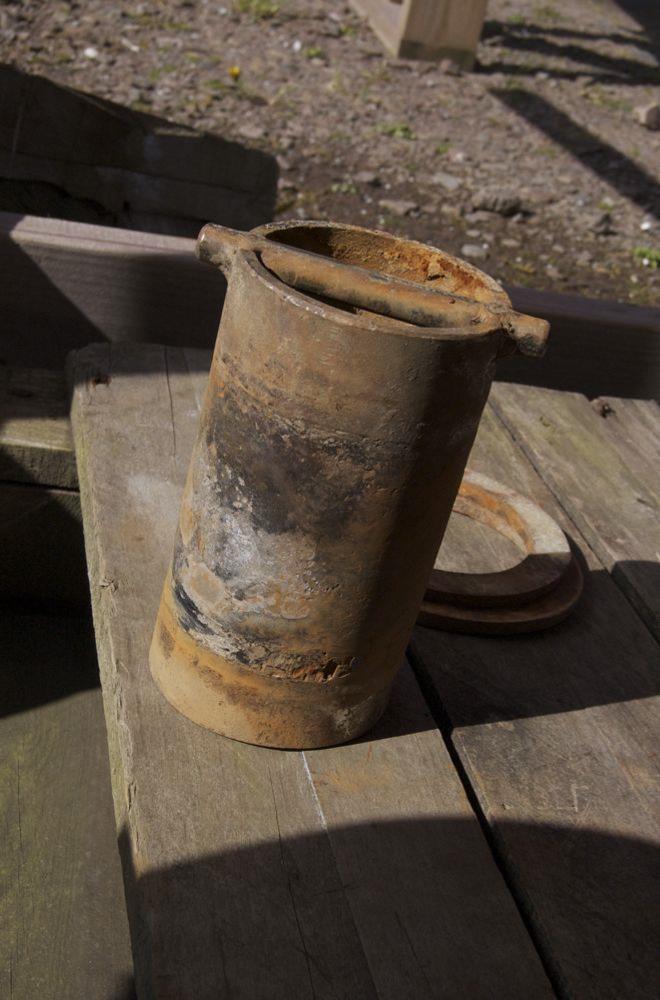
the fork in its correct place:
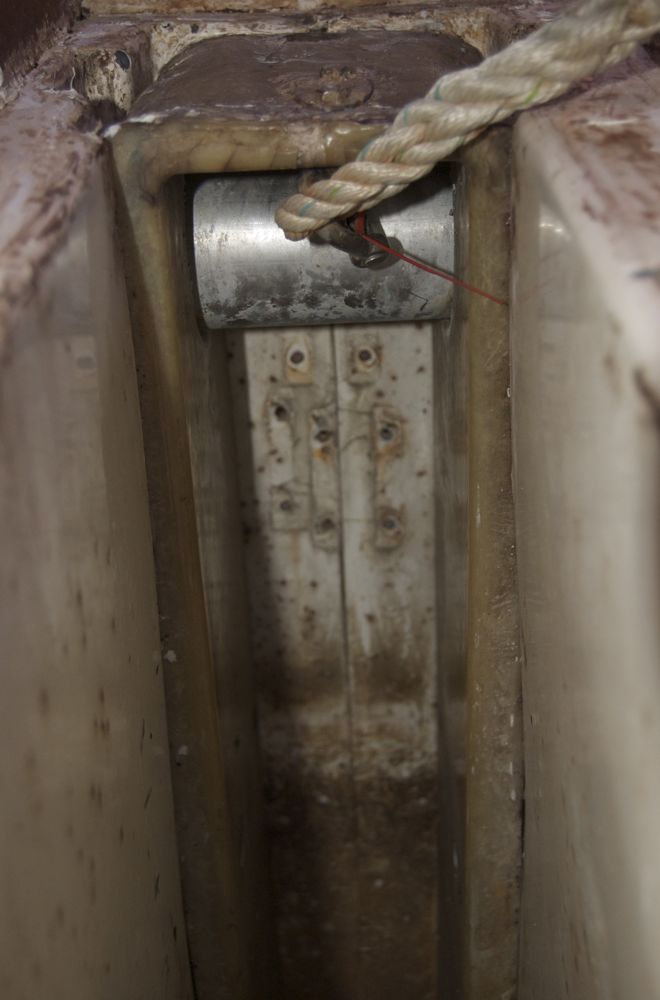
More pictures to follow, but I seem to have reached an upload limit with these.
Hi,
I became an owner of a F35 UK CB this spring and I have a few questions regarding the centreboard.
I will have to remove my centreboard this winter, as it has become stuck in the case. This could happen because the previous owner made an “upgrade” to prevent the centreboard from moving in the case. I am planning to get the boat out of the water for the winter in the next few weeks and put it a bit high on the blocks so I can work on the centreboard. Does anybody have experience with this? How deep is the centreboard exactly under the keel? And can anybody clarify the original construction with the “rubbing pegs” as on the drawing in the manual or is there an alternative construction?
Thanks,
Martijn