I have recently bought an 83 F39 PH and am in the process of fixing all the nonoperational systems. I have found the port water tank to be caved in on the side, I’m guessing by vacuum. Has anyone else encountered this? Also, how should the shower drain be connected, is/was there a pump located by the water heater for the shower drain?
Hi Tom,
The (forward) shower has a drain pump located in the pump farm beside the water hearter. PAR Model 37202-Series. Actuated with a) switch on the main 12V circuit panel and b) toggle in the shower.
I also encounter at time problems with the water tanks (port and starboard) for which I haven’t found a solution yet, because accessibility to tanks is nil on this particular Freedom. At time, the port/starboard tank will siphon itself in the bilge if I overfill it, to a point where the tank caves in. A mystery to me! I don’t have the slightest idea where the vent pipes are located, caving in should not happen if the vent is free. Other problem I have with the tanks when using the water pump. The breaker will go after a short time the pump is on, I checked the pump and pressure switch, OK, again I suspect the culprit to be blocked tank vents: if so, the air can’t enter the tank, the tank will cave in as water is pumped, the will suck desperatly and heat up.
Let me know if and when you find the vent pipes on the tanks, I’ll check mine.
Cheers
I don’t know if it helps, but on my 1981 F44 the tank vents are inside the chain locker, just around the corner to the left and tucked away in the corner of the bulkhead and the hull, just below the deck. The two hoses (same type and diameter as the freshwater plumbing hoses) are bent down in a sharp U-turn and held that way with a large tie-wrap that also fixes the hoses against the bulkhead. The U-turn could be such that the hose is squeezed. I also have a vacuum, when I open the deck filler cap, air is sucked in.
Michel,
Thanks for the hint on vent pipe location, will check in April…
I also experience a vacuum draft when I unscrew the filler caps. Correct me if I’m wrong, but isn’t a vent made to equalize pressure between tank and atmosphere? Did you experience high amps problems while pumping fresh water from either thank? If a vent is blocked, I’d expect the problem to be more noticable when tanks are full (will not cave in). I tried to run the fresh water pump with the filler caps off, it didn’t stop the pump breaker going off.
Yeah, so the vent hose must be blocked somewhere. It could be dirt or it could be the tight U-bend in the hose.
I haven’t noticed my tanks caving in; they are polyethelene (anyway, some kind of plastic) and the walls are a half inch thick. I never hear them pop in or out or anything. I never experienced a tripped breaker or extremely high amps on the fresh water pump. What I do experience is air sucked into the fresh water plumbing somewhere along the line.
If your pump breaker goes off with the tank filler cap off, there might be a blockage somewhere downstream from the pump. Perhaps calcium build up in the mesh of your faucets?
I tracked down both port and starboard vents, they are attached to the tank just outboard of the fill hose connection and are the gray plastic material that the water lines use. The starboard goes up and does a small loop along the outboard forward panel behind the electrical panel and then goes down below the cabin sole just in front of the engine. Both vents end at the same location, just in front of the engine. My vent hoses had a threaded end on the gray pipe but no connection. My port loop was very tight and crimped, it could be the cause of the vacuum problem. Suggest you look at yours as well.
My fuel vents run alongside the hull/deck joint on both sides of the boat and attach to vents going out the stern.
I found the shower drain vent, midship on the port side, there are two vents there, I don’t know what the second one is for, any ideas?
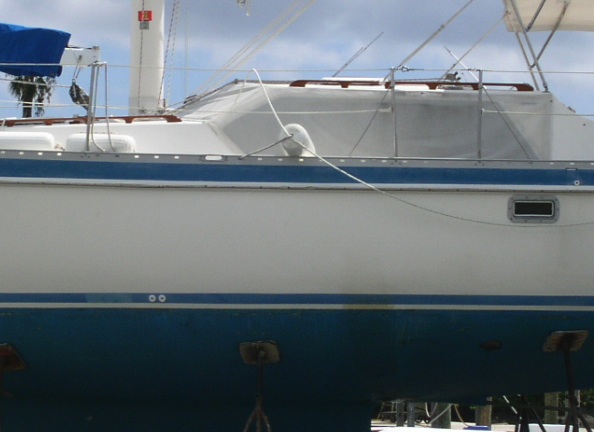
Siphons vents on the port side, yes, one is for the shower pump, the other for the bilge pump. They connect to the 2 through-hull above the waterline on the port side (see picture attached). Had to change both vents last summer Hard to reach, the through hulls are located behind the water heater, in front of the water tank.
Do you have A\C’s in your boat? If so, make sure that hoses coming out are vented. On my boat, they were connected directly to through hulls, without anti-siphon vent
So am I . These pipes come right out of the cooling unit and through the hull at the waterline. A proper valve at the throug-hull is probably what I should have written in the first place. Or is it being too cautious?
My A/C and refrigeration water outlets don’t even have a seacock, let alone an anti siphon valve. The 12v fridge water pump is self priming, but the 110v A/C water pump has to be bled.
Siphons vents on the port side, yes, one is for the shower pump, the other for the bilge pump. They connect to the 2 through-hull above the waterline on the port side (see picture attached). Had to change both vents last summer Hard to reach, the through hulls are located behind the water heater, in front of the water tank.
Do you have A\C’s in your boat? If so, make sure that hoses coming out are vented. On my boat, they were connected directly to through hulls, without anti-siphon vent[/quote]
My bilge pumps exit the boat out the stern, both the manual cockpit pump and the electric located in the bilge by the galley. I may try to use the second thru hull for an AC drain. I do not have AC but want to install a unit myself. Any suggestions on brand, size, location would be helpful.
I did not intent to use the thru hull as a vent but as a drain for an air conditioner I plan to install in the future, if the location works.
I guess that I’m confused as I assume that you mean a drain for the condensate as opposed to the raw water coolant. If that’s correct, how will the coolant ever make it over the vent loop? If not, please explain where you’re thinking of using it.
I’m going to have to add a box and pump for shower pump-out. I wish that the a/c unit were closer to where that’s going to be but with it under the galley sink I will either make my own “condensator” type venturi pump device or run the condensate into the bilge and let the bilge pump handle it.
The vent hoses and fill hoses on these tanks were mounted on the side wall of the tank several inches below the top. If you fill your water tank to the top and then place on the fill hose cap immediately after filling, you fill find that the vent hose will continue to siphon water out of the tank to the ends in the bilge forward of the engine until the siphon is broken when the water level in the tank reaches the vent hose fitting and air is introduced. You loose a lot of water this way. Try leaving the filler cap off for a few minutes to “burp” the tank. Water may still siphon out but only until this filler hose serves the purpose of the vent and allows air to equalize.
The water tanks may be secured in part with two-part pour-in-place foam which would serve to glue the tank to the hull side.
Mark Edwards
Mark,
At last a proper explanation to the mystery of the self draining tank on my PH39. I tried to explain this self-draining phenomena to other people, they’d think I was crazy…
 . These pipes come right out of the cooling unit and through the hull at the waterline. A proper valve at the throug-hull is probably what I should have written in the first place. Or is it being too cautious?