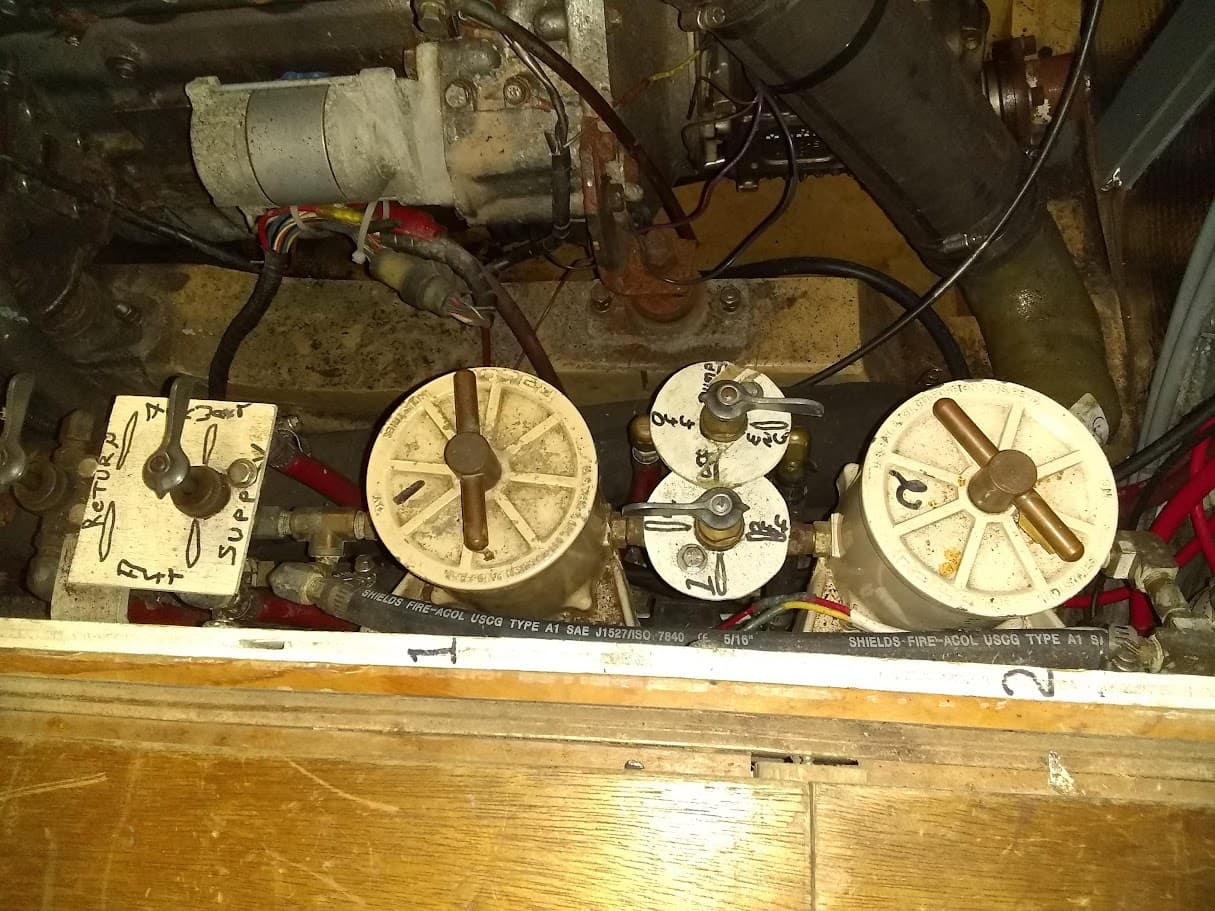
I had another out of fuel incident. This time it appears to be related to an air leak in the fuel supply circuit. I believe I have addressed this.
Meanwhile I had another hassle getting the boat primed. This was due to the very short throw on the fuel pump lever. I tried Camino’s approach which was to release the compression levers and try to find a spot on the cam that provides more lever throw. I did not make much progress. However I did manage to leave the compression levers in the incorrect state so I discovered what a start sounds like with no compression . There is more to the story…. I will spare you.
Anyway, I was reading this forum and others and the idea of a separate and ample volume priming pump in the fuel line before the primary filter would eliminate the need to use the engine fuel pump. This sounds like a great idea, A nice decent volume and easily accessible push button pump. Has anyone done it and if so what pump did you use?
Thanks to Murphy, once I have this new pump installed I will never need to prime again.
The lift pump on my engine was leaking (for more than a while whoops) and I bypassed it with a Facet Solid State Fuel Pump - 40105. Amazon: Amazon.com: Facet Solid State Fuel Pump - 40105 : Automotive . I found it recommended on a forum talking about the Yanmar 2gm20f and have had excellent results this season. I know people are touchy about electric pumps, but it sounds like it would be good in your application at least.
One thing I’ve seen recently that might also be of interest if you’re installing a secondary fuel pump is to make a fuel polishing loop on the side.
Oye veh Mike! I feel the frustration! Also difference maybe in engine hours - on my 3 gm30f is have about 900 hrs (1999). If my fuel pump lever is not spongy in the bottom with ample “throw”, I will flip the three compression levers on top and hand pull the v belt up til the fuel pump lever is nice and spongy with good movement ( did you hand pull the belt to crank the engine around?). Also I have installed an engine start button in my inside electrical panel to help me if needed bump the motor around to the right spot. And always return the compression levers back to normal! . If there is a leak in that system then your idea would also benefit. Let me know. Plus let’s meet up one of these times!
Forgot to add- a couple years back I had an air leak at my secondary fuel filter, mounted off the side on the motor- the secondary fuel filter is a bolt on unit, I bought a new one at BMW for cheap and installed. No air leak. And yes to pre-fill both racor and secondary fuel filters with fuel.
As JoshGrff mentioned above I did build a polishing station years ago and being a belt and suspenders type of guy that sails singlehand most of the time I plumbed the systems so the pump for the polishing station would also feed the engine, in my case a 4jhe. I don’t have the specs for the pump at hand but at the time I just matched the Yanmar spec for the manual pump for floe and pressure.The picture does not show the pump but it is under all the plumbing and racors. The entire system is mounted to a board and can be removed as a unit.
Hunting for air leaks can be tricky. Recently I changed fuel filters and caused air to get in the fuel system which made for a stressful launch day.
The Yanmar fuel pump lever has to be pushed relatively slowly all the way to the bottom to get any fuel pushed through. You will not feel much resistance till you get to bottom. Should the fuel line be more air than fuel it is unlikely to pump much if at all. This can take a very long time to fill the secondary filter. So both filters need to be hand filled. Also it is not really self priming and does not move much fuel even when primed.
It may be time for a new fuel pump. The pump itself could have a leak. The pump fuel line has banjo bolts and copper washers.
In any event both primary (racor) and secondary (engine) fuel filters need to be filled first. Might as well change filters. Also if there is a fuel shutoff between racor and tank close it to keep fuel in line to tank. Remember to open when pumping or starting.
I am going to try a vacuum pump at the bleed screw next time.
I have a F35p. I put a squeeze bulb (think outboard motor) in line with the pump and can use it to fill primary and secondary filters. A couple hose clamps and maybe a bit of fuel line. Working great 10 yrs.
Pearce, Yea, tricky is right. I think I got extremely lucky but still need to test.
Independent of the fuel issue I managed to foul my pump dry bilge pump which keeps the very shallow shaft well dry when motoring and allows me to assess how much water is actually entering the boat via this leakage (about a pint an hour right now).
Anyway, to clear this I had to unmount the Racor assy. and move it, still connected to lines, out of the way. As I was doing so I noted slight fuel leakage from the filter/sight bowl joint. I had recently replaced the filter and, apparently did not tighten it enough…fingers crossed. Meanwhile I ordered one of these small fuel bottles from Amazon so I have a small container I can use to top up filter bowls as you have recommended and, based upon my experience, totally agree with. Of course, once I have that bottle I will never need it. I am good with that
Fortunately I just replaced both prime and second filters so they should be good condition but as I refill the system I will verify this.
With regard to the fuel lever. Yes, I do know there is little “pay dirt” travel. Maybe 1/4 inch or so. I have replaced that pump before…please God, NO!! I actually have a spare because this replacement did not fix my problem, this was years ago before I had a clue re troubleshooting the fuel system. My thought in asking the question re priming pumps was to simply provide more oomph and easier physical access. It is awful leaning over a hot engine pumping that stupid little lever that delivers about 10 drops of fuel per lever depression. You are absolutely right re time, It took me an hour to manually fill the filters last time (only time) I ran out of fuel due to negligence.
Thanks for the insights. The picture Jdpandip posted showed a top loading Racor. Mine has the plumbing connections on top and the filter/bowl assy. swrew up intro the top. This is a PIA when changing filters in the very tight space available. A top loader would solve that problem and make it a lot easier to fill the system after replacement. Someone also mentioned a polishing system. I will look at that but space is so tight I am not sure I could accommodate it.
I have about 2600 hours on the motor. “Jacqueline” was built in 86. She has no hour meter but I keep hours in my log and am pretty confident in the numbers, although I had to extrapolate my use to the previous owner to come up with a starting point so that might be a bit flaky,
I put about 200 to 300 hours on the motor annually. Since 2015 I have been going up to the Bay frequently for SSS events so that has increased my annual motoring. Although one can sail the trip, and I have, it just takes forever and about a thousand tacks. I mean Freedoms are perfect for this but…
So what happened was I departed my dock in Discovery Bay and got about 1/4 mile before running out of fuel. I had to drop anchor in the middle of one of our access channels to troubleshoot, so that was a little embarrassing. Sure enough, the boat is out of fuel and I gotta prime. So I try to use the “Camino Method" by opening the compression levers and rotating the engine to try to get a bit more useful lever throw. This did not work for me. I don’t know if it was incompetence or nervousness being anchored in channel traffic or what, but did go to direct filling using a plastic cup. This got me to the point where I was able to get bleeding accomplished. But I did notice the bleed was not as robust as usual I did not get a gush I got sort of a weak weeze, but fuel flowed and I tried a start. All I got was a mechanical whine and no action . What the hell?? so I gave that up and got the Jib rigged so could sail home - very very slowly.
When I got back to the dock and secure I am thinking to myself “did I close those compression levers?” The rest is history
I did a search on fuel polishing systems (simple ones) and I get the impression what one is doing is sort of pre-filtering the fuel: pull fuel from gnarly bottom of tank through filter and fuel water separator and then back to the tank, rinse and repeat on a continuing basis thus collecting junk before it can even get to the ops critical filters. Sounds very interesting/useful if it will fit. Can you link me to the design you implemented?
Looked at a few commercial units available at the time and stole the principle. In practice I got a used Racor 500 series of E-bay and got a compatable pump from Amazon. In my case the flow is: From the three way valve used to select which fuel tank to a three way valve that selects which filter to use. This flows to a three way valve that selects whether the flow goes to the electric pump or to the engine. From the pump the flow goes back to the tank it was drawn from. This flow can be diverted to the engine for priming or to run the engine if the engine mounted fuel pump fails. The second flow when engine is selected is the supply line to the engine driven manual pump. In practice I use filter 1 for engine operation and filter two for polishing though either filter can supply the engine and have had to change from one filter to the second when fuel starved due to a clogged filter. I run the polisher mostly during the winter to control condensation and tank gunk (technical term).
This is a great idea. Installing an independent oil injection pump can indeed solve the intake problem completely. Technically, low-pressure, high-flow plunger pumps or diaphragm pumps are more suitable for oil injection and empting than ordinary turbine pumps. However, when installing, it should be noted that the position of the pump is best lower than the bottom of the oil tank to use gravity to help draw in the oil. In addition, it is recommended to add a delay relay to the pump’s circuit. Pressing the button will automatically run for 10 seconds and then turn off, which is more convenient than holding it down all the time.
I have found an outboard motor fuel “bulb” works great. I have installed one on three different boats and find them an easy way to fill filter canisters when changing filters, as well as priming the fuel system. Cheap and simple!
Replaced my primary filter with bosch one with a pump works great air shoots out bd scew ps dont getone with a glass base ,dispitebing very thick mine fractured into three pieces
 . There is more to the story…. I will spare you.