Exploring upgrading my anchor for F33. Considering Rocna Vulcan or anything better if there is. 20 kg or 44 pounds is recommended. Wondering if anyone has any thoughts about me just purchasing a 33 kg 73 pound anchor for the F33. Other than some added weight in the bow , I should think it would just be that much better even if it is a bit of overkill on a fair day.
Hello,
Last year, I ordered a 15kg Rocna anchor. I am convinced that this is the right size for my F33.
Needless to say, a 33kg anchor seems far too oversized to me.
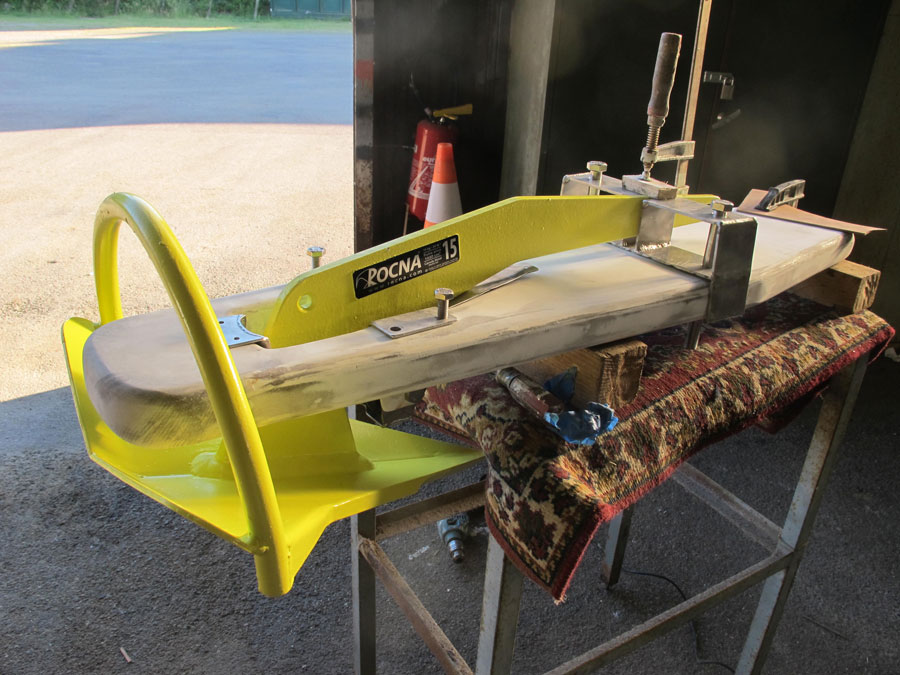
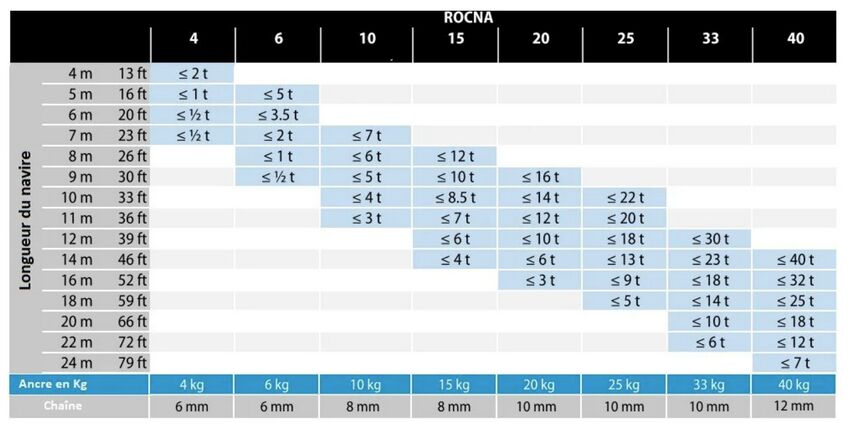
Beautiful anchor…. Both AI and the chart Rocna has indicated 20 kg minimum for that boat.
Of course how much chain rhode , bottom conditions and the weather itself effect things greatly. We get crazy gusty high wind weather systems off the mountains plus I admit I am influenced a bit by friends who do offshore sailing. Their tackle is more extreme I suppose . You have given me something yo consider. Thanks
Carl
I still disagree.
We haven’t seen the same table. The one I consulted directly on the Rocna brand website shows results that match my choice.
I’m planning a trip for the Freedom 33 and have looked at quite a bit of information on anchors. Maybe I should have chosen the model above (20 kilos), but modern anchors are much more effective than older ones like the CQR.
You will likely be fine. I am certainly far from being an expert. I just like a peaceful sleep in the worse weather so I tend go do everything to the extreme. All my hoses will be getting the best clamps available and double clamped.
I will have the correct screw driver hanging in plain view in case a clamp should fail.
Such is my nature
Carl
I was an early adopter of the Rocna, and think that they’re very good anchors, but for my Knysna 550, I went with an Ultra. The key differences is that the Ultra has a weighted tip which does a much better penetrating bottoms with sea grass, and it’s polished stainless which allows material to stuff off much more easily, so it comes up clean.
A couple of days ago, the Knysna Yacht Club had their annual raft-up, and BlueJacket2 was the center boat with a dozen boats rafted to her in a lagoon where the current rips (5’+ tidal range). The anchor and bridle held fine, even through a tide switch. Great way to test the anchor system!
1 Like
I have to say thank you for your comment. Real world experience that is useful with my decision. I live in British Columbia Canada in the Pacific Northwest so now the question would be size of an ultra for my F33. Specs are 12,000 pounds for the vessel. Do I go with the charts or go up one to the next higher suggested weight?
The compromise question is the increase in weight of the anchor and chain in the bow versus reducing extra weight to avoid impacting performance and handling underway.
Considered larger weight anchor and more chain but it seemed too much weight and would not fit my existing bow roller. The setup I landed on is the Rocna Vulcan 15 (33 lb/15 Kg) with 90 ft of chain and 200 ft of 8 plait 5/8 rode on a lewmar pro windlass.
This system worked great up in Maine this summer. Anchored 5 out of 11 nights. Being in sand and mud with 7x to 5x scope and a good distance from neighbors meant no drama. It only blew over 25 kts one day.
We had a similar ground tackle discussion not too long ago. I believe the Ultra, Fortress and the Spade got some mentions.
This chat has reminded me to revisit the question of a second/backup anchor. Not sure I am ready to go full Kevin Boothby and get an old school fisherman yet - ha ha
Anchor windless and anchor size
I think I have posted SV Panope has an extensive anchor testing channel in the past.
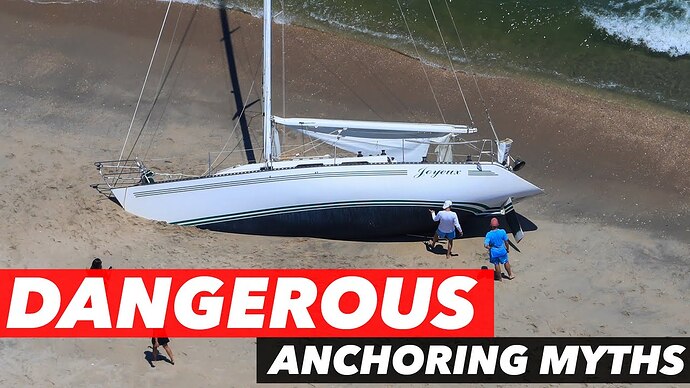
This recent YouTube from Practical Sailor was interesting:
I have never heard someone say i wish my anchor was smaller, but i have heard many say I wish it was larger. Id put the biggest anchor you feel comfortable with on your pulpit assuming you have a windlass. On my last boat, I had a rocna 15 with 30’ of 3/8 BBB and no windlass. While that anchor held my columbia 31 like a boss, it was a back breaker. I am beyond happy to have a windlass now.
Think of an oversized anchor as an extra insurance policy.
I have extensive experience with overnight anchoring on my F40/40 on Lake Ontario, where the weather can change from 10kn wind to 60kn wind in a couple hours. A 33 kg anchor is massive for a 33’ boat. My F40/40 has an oversized Delta at 55 pound/25kg anchor, and that is quite adequate.
The size and type of anchor is not the most important consideration. Equally important is 1) how you actually set the anchor, 2) how much and what kind of chain and rode you have, and 3) being very judicious about where and how you set your anchor.
Chain length, the more the better: If you do not set out enough chain to keep the pull on the anchor horizontal to the sea bed rather than vertical, it may not matter how heavy your anchor is. Too little chain even with extra long nylon rode can result in vertical pull in a blow, which can dislodge the anchor. You will find lots of differing recommendations on this, but I recommend you have at least 150’+ of chain.
Choose your chain properly. Chain is heavy, but the tensile strength of the chain is should be considered. 3/8” low grade 30 tensile chain has about half the working load limit and is twice as heavy compared to high tensile 5/16” grade 70. 150’ of low tensile 3/8” chain weighs about 225lb while 150’ of high grade 70 tensile 5/16” weigh about 120lb. So 150’ of grade 70 weighs about as much as 75” of grade 30 so keep this in mind if you plan to increase the length of chain to your ground tackle and want to avoid weighing down the bow. Keep in mind that if you change the size of the chain, you will have to change the windlass capstan to fit the chain, which is not hard to do.
Attaching the ground tackle to the boat: chain does not stretch, while nylon does. Always use at least a 20’-25’ bridled snubber line to cushion the pull on the boat because if a blow comes up, having chain without a snubber line will jerk the ground tackle with every wave which 1) will be very uncomfortable below, 2) can cause the anchor to dislodge, and 3) can damage the windlass. A double bridle line should be used attaching the port line to the port cleat and the starboard line to the starboard cleat and both attached to the anchor by either one or two snubber hooks, with a long length of chain loop below the hook to prevent the hook from dislodging from the chain. I see some people secure the chain to the windless without a snubber. The windlass is not designed for this and you may be in for trouble in a blow.
Always prepare for a hurricane any time you set the anchor. It is easy to get complacent when you set the anchor on a beautiful day with a gentle breeze anxious to have a cold brew, but conditions can rapidly change on the ocean or Great Lakes. There is nothing more miserable or frightening than having to haul and reset a dragging anchor in a 60kn blow in the middle of a pitch black night. Perhaps you already know this, but I will write it anyway. Drop the anchor and some chain while slowly reversing, stop the thrust, secure the chain to the boat, reverse hard to let the anchor set, then repeat several times until you are at the depth/scope ratio you desire, then reverse hard a few more times with a few minutes in between to ensure the anchor is set. Set an anchor alarm and take a visual of the nearby land and remember it. You can use your chart plotter anchor alarm, but that uses a lot of battery storage. I prefer a phone app. I use AquaMap, but there are others. You set the distance you will swing on the app and if you go outside that circle, a very loud alarm goes off. I am always anxious when I leave the boat unattended such as to go for a hike, so I activate my anchor alarm, leave a i-pad linked to my i-phone which I take with me to alert me of a problem.
Know what the bottom conditions are that you are setting the anchor in. Sand and mud are fairly each to set the anchor, but anchoring on hard rock sometimes is impossible. If you do hook you may hook a small rock, the anchor may dislodge if a blow comes up. If you hook a large rock, you may have trouble getting off it when you haul anchor. If you are setting on rock, run a line from the eye on the top of the anchor to the boat or to a floatation device to help pull the anchor loose if it is stuck on a the rock. Just as importantly, be very careful setting in weeds. You may think you are hooked to the bottom only to realize in the middle of the night that you were hooked to the weeds, not the bottom. That can be a nightmare.
Hooking a power cable or a log: This happens. Raise the cable or log as high as you can, take another line and run it under the cable or log, retrieve the free end of the line and attach both ends to the boat, bringing it as high as you can, then let the anchor down. You can then release the line holding the cable or log and raise the anchor again.
Secure the anchor to the boat after hauling. I once had my main anchor come loose from the bow and drop to the bottom in 100’ of water in a 25kn wind and 6’ waves with 160’ of chain and 300’ of rode. That was not fun. It will never happen again. I see people securing their anchor on deck with bungies, twine, old frayed rope, or just with the chain around the windlass. They are asking for trouble. I secure each of my 2 anchors with at least 3 solid lines. I have a 5/8” line attached to an eye on the underside of my cleat (inside the anchor locker) with the other end attached with a snubber hook to the chain. I also have several solid 1/4” lines tied from each anchor to either the boat life railing or foot rail. I also wrap the chain around the windless.
I hope this is helpful.
1 Like
Thanks. That is useful information
Carl
40 pounds would be lots then and maybe too much for the 33
A 40 or 45 pound anchor would be OK. It’s slightly oversized but not like a 75 pound anchor. 45 is about what’s recommended for a 40 foot boat and I went a little larger. As I said above, focus on all the other aspects of anchoring with a good anchor and you’ll be OK. Roncha is a good anchor.
If you want to start an argument in a Yacht Club or waterside bar, just mention anchors (or flag etiquette). The jump in performance from CQR to Delta (cheap) is greater than from Delta to anything costing three times more. 15kg is correct, with lots of chain - 10mm best if you can carry the weight.
Sounds reasonable though I am leaning towards a Vulcan. People love them here in the Pacific Northwest and many vessels are being refitted with them. Less Bruce anchors being observed these days here.
I carry a Bruce claw as my secondary anchor. It is ok, but nowhere near as good as the Delta I have for my primary anchor. I only use the Bruce when I want to deploy 2 anchors at the same time spread out by 30-45 degrees. I try to avoid 2 anchors because if the wind shifts, the 2 anchor chains twist around each other, which is a major pain in the butt to haul.
The CQR that came with my boat that I replaced with the Delta was terrible. The CQR is best used for a decoration in your yard. The Vulcan is probably better than the Delta, but nowhere near the difference between the CQR and the Delta.
The only CQRs and claws I see are on boats that probably seldom anchor overnight.
Imagine designing an anchor after a farm implement who’s purpose is to be dragged through a field. CQR - Crappy Questionable Reliability.
Love my CQR have great luck with it especially if/when wind shifts. Also use Bruce and Fortress.
My experience is that rochna is a pretty good general use anchor. The size chart suggest the anchor required…from memory…in silt bottom 50 kts wind parameters. I had a 6500kg 35ft mono with a 10kg rochna..way under the suggested anchor. …only one available… It worked well in strong winds all through the Atlantic Islands. In anything 40+ we had shelter from surrounding landscape so no real sea state and plenty rode..5to1…with only 15m chain for seabed abrasion. All held well but of course woukd have loved a 60kg. . But 8 guess i would of thought that with a 30kg as well.
On our 48ft cat we had a terrific super max sea…15m chain. Awesome, but not great in kelp or rock, so had a 20kg fisherman’s too…bought that in adelaide after walking down the dock looking at the local preference.
I suspect you’ll be fine with your 15kg rochna, and on the 1 in 15 years you may need something bigger chuck another one in the line.