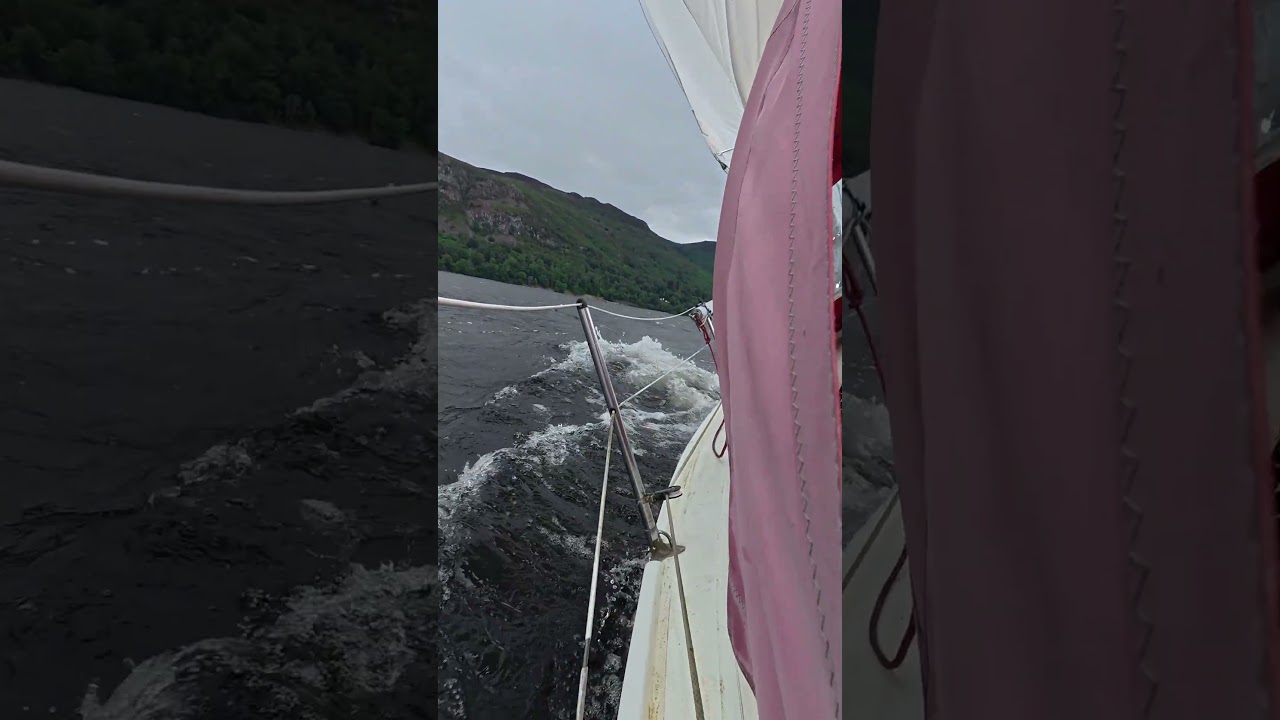
I’m hesitant to heel over too far (>20 degrees) because I’m afraid of going all the way over. this makes me slower in every race. Presumably the weather helm would pull it into the wind, and the keel would act to pull it back up, but how much water would I take on in the meantime? Clearly the scuppers would handle the cockpit water, but how much water would the cabin take on? Should I close the companionway while I’m racing? Would I take on enough water to sink the boat? Or is there enough flotation that even if the cabin filled with water, it wouldn’t sink?
I tried searching for this topic, but didn’t find anything similar.
Hi Russ, I’m not sure how consistent the wind you have is, but I think your concerns are not really justified whether gusty or not. You have more freeboard than my F21 and I regularly sail at 20 degrees plus with the gunnels in the water. That is because the winds are so gusty on Derwent water. We hit 30 degrees last week and still did not get any water in the cockpit. I have probably been to 40 or so in gusts, when my F21 just loses rudder authority and heads up to wind. However we do not have any big seas the water there is flat. I think the F25 capsize screening formula is 2.24 but that is a bit of a rough measure. They say 2 or under for offshore racing. Even if you get a wave over the cockpit, the companionway is high and I don’t think you would ever get more than a few bucketfuls splashing into an open companionway, at least when inshore sailing. That would hardly make a difference to buoyancy. I’ll post a video of our sail last week in very gusty conditions. I find the best solution if you are overpowered in gusts is to just come up to wind a bit and spill some wind… a dinghy racing technique. You point higher overall this way. I’m not sure about the F25 but my F21 goes well at 20deg and doesn’t mind gusts over that. We were making 6knts upwind at times last week with the gunnels just on the water.
It can be gusty. Sunday the typical wind was 18kt, but 20-22kt gusts were common, and the peak was 24kt. I’ve been told that I have nothing to worry about, but that’s hard to accept when it feels like I’m looking down at the water (I exaggerate). I’ll try going up to 20 and see how I feel, thanks!
I was out in 24K gusts a couple days ago on my 25, first reef in, heeled to the toerail regularly. Head up a bit in the gusts, traveller down more in higher wind. I had mine halfway between the hatch and far end, mainsheet in hand. As far as the fear of sinking thing, even at 90 degrees there is enough boat in the water (displacement) to keep the companionway above water by design. Probably.
Yeah, I was looking and thinking and mentally measuring, and I think that 90 degrees the companionway would still be above water.
I don’t know how to use my traveller. I keep it centered all the time, and adjust the sheet as necessary for the angle of travel. How might I learn to use my traveller?
Don’t think 25’ would be much different from 21’ where we were told to keep the traveler just passed, inside, the companion way rail. At this location you can bring in the sheet completely in and still be fine. Sheet fully in and traveler in the middle going upwind will just cause setting. However, such position is usable if you have the jib raised.
For reaching and going down wind, traveler is used more or less like on any other boat. This you could learn by reading up on the “sail trimming”
Re: Traveller: I am in my 5th year with the F25 and don’t race it. I got rid of the vang so I use the traveller to manage twist (maintain the sail shape when opening up a bit, for instance) I’ve always preferred sailing a bit wide to keep speed up at the cost of a few degrees pointing, cold northern fresh water chop needs power. Google “polar plots” to get an idea of how angle and speed relate. The thing you want to maximize is VMG upwind.
I generally put the traveller at the edge of the hatch, or halfway from there to the edge, or all the way down then fine tune with the sheet. YMMV.
Yes, you have both weather helm and your control of the tiller to point up, spilling wind, or of course you can ease the sheet. As others have noted, you will not get water in the cabin but it doesn’t hurt to close the companionway-- or drop one board in. Then have at it and see what happens! No, you won’t sink the boat.
True story: sailing a Cal 25 in a race, a line squall it. 60 knots. I was on the leeward side trying to free a sheet and the winch and I were in the water, just like that. The boat rounded up some, the water drained from the cockpit, we eased to luff, and continued on after quickly dropping the jib. Exciting story, no danger of sinking.
I know it seems frightening at first but you soon get used to it and more importantly you will gain confidence in you boat and its ability to handle the weather.
That’s helpful, I think? It looks like I shouldn’t try to go straight downwind for maximum speed with just the main’sl, but what about using the spinnaker? Does this polar plot take that into account?
From my experience, yes pretty much the same, at 30-40 degrees off dead downwind you will be going much faster. Of course if you are travelling from A to B you will travel more miles not sure where max VMG is but it is more fun .
That plot is AI generated and does not include the spinnaker, but the principles are the same.
Tacking through about 90 degrees is a good starting point upwind. If you are heeling a lot (over-powered) you are losing ground to leeway, ease the traveller (or reef). Sea state and currents are factors, not considered.
 .
.