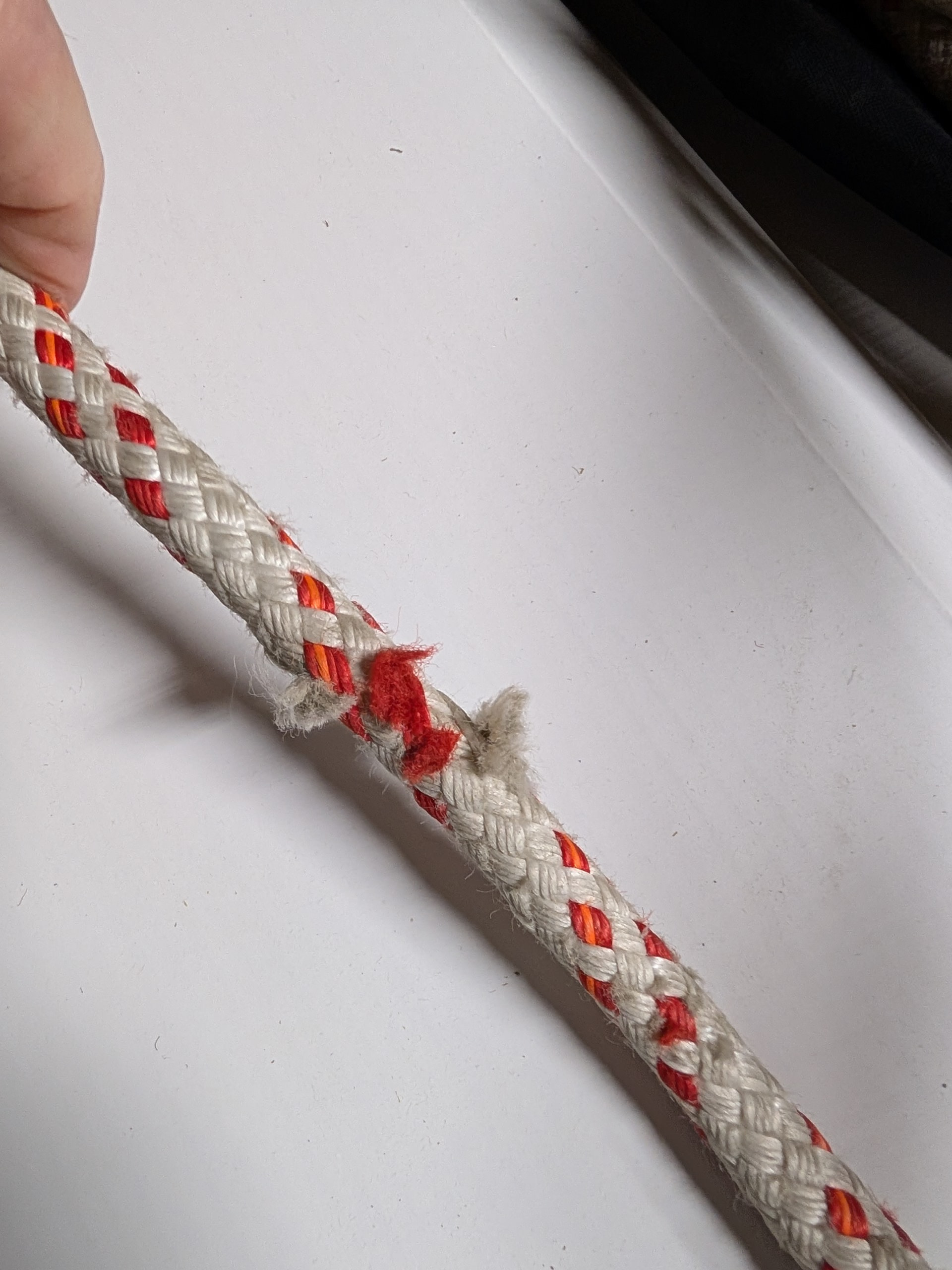
I remove my halyards when I expect the boat to be unused at the dock for more than a week or two. When I removed the main halyard yesterday I observed this damage mid halyard. I am wondering what to make of this. Is it time for replacement?
The cost of low stretch line these days is not compatible with my low stretch budget. Is this useable or am I going to have to replace?
The line feels solid but obviously there is a failure of some sort.
Yikes! Mid halyard suggests a possible problem at the masthead sheave, perhaps a cracked edge, causing the fraying while the main is down and the halyard tied off? Tough to inspect without a trip up the mast unfortunately.
I would definitely replace it, but still need to find the cause. On the bright side, you might have enough on either side of the fray for a spare jib halyard since it is much shorter…
Mike - agree - replace it. I keep my running rigging in place all the time. I do replace my main halyard ea 2 yrs. Jib halyard is 10 yrs old but looks new as it’s up all the time and sheaves look good. Sometimes I use a drone to get close to the masthead and I can clearly with zoom what’s going on….
Been there, done that. I have a three foot Kevlar sheath in the area where the halyard reeves through the pulley when sail is down and another at shackle end to protect when sail is up. I said mid halyard but that was an offhand remark. The damage is about ten feet from actual max hoist point to the reeving loop end of the halyard. If that makes sense.
I inspected the sheave when the mast was last down and found no obvious burrs or other sharp things. Admittedly this was quite a while ago. I attributed earlier wear to extended periods (several weeks) with sail fully set in seaway. Perhaps this is more about the wrong diameter halyard? I suppose it could also be related to more recent sheave damage and only does harm when reefed? The halyard is about 8 or 9 years old now.
The bottom line is it sounds like there is agreement I need a new halyard, I’ll need to decide what to do about sheave inspection. The list of to dos at the masthead is getting longer.
Every two years…ouch. What rope are you using and who is rigging it, if not DIY. I’ll check prices. My jib halyard is getting up there and I did cut a chunk out of it some time ago, same type of damage but closer to an end and I could take a bit of a hit on halyard length. May just go ahead and replace them both.
Hi Mike - my main halyard 7/16 Dacron Aramid Braid (or similar) 120’ - it’s not that important to me as I replace it ! I’m sure folks will definitely chime in on what type of rope. Just replaced my jib sheet which was 10 yrs old. Main sheet is old too but in great shape. Just really my main gets wear. We’ll have to get together - I can go up your mast and check out that sheave
if that’s sta-set or sta-set X you definitely have to replace it, since it is a cover-dependent line. I just replaced a jib halyard with samson xls3 - dyneema core, easy to splice, won’t catastrophically fail if the cover gets nicked.
Guessing the wear may be at one of your reef levels.
I’ll be replacing both my main and jib halyards this winter, and setting up a slightly different camber spar topping lift. I think topping lift is currently set up using what was a spinnaker halyard.
Yes - you have a chafe issue - if you wanted a temporary fix, you could move the point of wear, by shortening the halyard at the sail head end, by say, 6 inches… that would shift the wear point off the aggravating rubbing point. You would be surprised how strong that line still is though - even with that chafe on the external casing. Any help?
Dyneema is the brand name for hmpe, which is what the core of mlx3 is. Mlx3 can be stripped if desired. I’ve gotten in the habit of stripping at least 2’ - 3’ from the shackle end because it’s much easier to do a Brummel splice in the core than to do a covered splice, but if you are at all worried about chafe then don’t strip it.
A couple of years ago I had a similar problem with my jib halyard due to the mast pulley breaking resulting in sharp pulley fragments cutting the halyard. The halyard definitely needs to be replaced but not before you fix the problem at the mast head. There are few things more frustrating than sailing along and suddenly the main drops onto the boom
Replacing the halyard every 2 years seems excessive. It should be more like 8-10 years. I use Samson XLS for all my lines. It is good stuff.
I would disagree about needing to replace the halyard. It has been my understanding the the cover of sta-set provides little strength and is primarily there to provide UV protection.
If ever there is a place to splurge on rope with a dyneema core, it’s the main halyard. I remove and inspect mine at the end of every season, and it’s still looking good after 8 years of use. The area that goes through the rope clutch is a little chewed up, but that’s to be expected. I don’t remember the exact diameter, but it’s Endura braid from NE Ropes. I picked up a length of it for 1/2 price from West Marine in their remnants section. The only issue is the color: a pale gray. Pretty much any other color would have been better, as it’s light enough to blend with the mast and disappear in dark/stormy conditions. This has masked the fact that the slack halyard has wrapped around the front of the mast and caught my radar reflector or foredeck light. After nearly ripping the latter off once when shaking out a reef, I’m always careful to check that I can see the whole line before I hoist the main. That would be much easier with a nice dark blue halyard, but us beggars can’t be choosers I suppose.
I did say at the beginning that everyone will have an opinion on halyards As my main halyard looks a bit frayed and grungy I just ordered a new one - actually my last one I tried to save $$ and ordered it a wee short- so when I tie onto it in my harness my wife doesn’t have strength enough to wrap around the power winch and press the button - I have to sit on the boom to give her the length to wrap and hoist ! So with the full 120’ of new sta set all should be back in order. And right on wrapping the halyard around the front of the mast. My loudspeaker/ hailer is there and I’ve ripped off 2 of them not paying attention to where the halyard was!
I have been following the exchange regarding your worn main halyard.
The photo you provided suggests to me friction possibly through contact with another halyard.
I raise this since the one subject that has not been discussed is how freely your main halyard - or indeed your spinnaker and jib halyards - run inside your mast. And that’s before you consider your masthead and deck light cabling. A few years ago I replaced my mast wiring looms - the mast was down - and discovered to my horror that the halyards and old wiring - the halyards had been installed by rigging professionals - were entwined. Not one single halyard actually ran freely from its sheave to its deck exit point. It was a “serpents honeymoon” inside my mast!
By careful use of “mousing lines” I was able to unravel the mess and ensure that all halyards and wiring ran clear of each other. It sounds simple but you’d be surprised how many masts contain a jumble of rope and wires. When raising the main, for example, you tend not to notice any restriction - the weight of the main camouflages issues - plus at some point the main halyard will be wrapped round the main winch for the final lift - and we all know how powerful that winch is.
Also now that the outer covering has been breached, you need to ensure that the inner covering does not develop a “hernia” as that will be impossible to pull through either a sheave or a deck clutch.
You’ve still got time to ask Santa Claus for a new main halyard.

 I did say at the beginning that everyone will have an opinion on halyards