Totally agree. There are accessibility things which could be improved but the basic low tech, repair it yourself, simplicity really stands out when mechanics cost $200 an hour.
Also agree on parts, readily available. Svendsons in the Ca bay area has a bunch of parts bins dedicated to the 2 gm. If one can’t find it in a bin they can usually get it in a day or two.
Out of curiosity what is driving your top end rebuild. Are you doing the work in situ or removing the motor from the boat?
I have done injectors, raw and fresh water pumps, mixing elbow, exhaust system, fuel filter assy, alternator, serpentine belt upgrade, Heat exchanger disassembly and cleaning, fuel pump replacement, all hoses, shaft disconnect and reconnect, shaft seal and motor mounts…just about everything ancillary but the starter motor.
I would approach the “top end” with great trepidation though. How tough do you expect the job to be?
I had two issues I was trying to address. First is difficulty starting, especially in cold weather. It’s been getting worse over the past 2 seasons and I have been dealing with it by using a minimal amount of starter fluid as needed. However I’ve learned from the Yanmar tractor blogs that starter fluid is a very bad idea and can damage the engine. Second reason was that my engine was filthy with peeling paint, oil and surface corrosion, and I wanted to clean that all up and repaint it.
I bought a compression tester and got good results in spec. Based on that, I decided that the pistons and rings were OK so I could just take the top end and everything else I could pull out and work on it over the winter at home. In the long run pulling the engine out would probably be more efficient, but where she is on the hard over the winter, that’s not an option for me.
Other that the cylinder head, what I’m addressing (or have addressed) matches your list exactly. Shaft seal and motor mounts were done a few years ago.
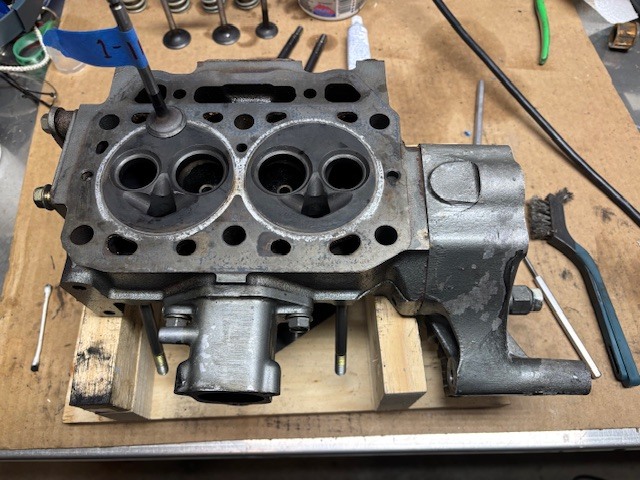
After removing the cylinder head, everything looked in such good shape that all I’m doing is scraping off the carbon deposits and lapping the valves. In fact everything looks so good that removing the cylinder head probably wasn’t even necessary, but I guess now I know. Here’s what the cylinder head looks like on my workbench after I lapped the valves today. They did have some pitting, especially on the intake side.
Interesting. At this point I have no reason to do a job like this but the engine was built circa 1986, I mean how long can this darn thing run? I try to take good care of it and have about 2500 hours. But it’s almost 40 years old, that’s amazing to me.
BTW, don’t know if is available in other states but I use Shell Renewable Diesel fuel. No smell, excellent cetane and superb starts. I love this stuff. Have been using it for three or four years now. I buy mine from a service station and pump into jugs but they sell it a some fuel docks here in the bay area.