There is only one Freedom 70 that was built in 1980 and launched after the London Boat Show of 1981. After the collapse of Fairways Marine when its parent company, the Shobokshi Group, failed to send the committed £1 million of new capital. The Freedom 70 never went in the Whitbread Round the World Race which she would have undoubtedly won because of that sad ending. The Freedom 70 had a private race arranged by Rob James with the owner of Flyer, the boat that did win the Whitbread. Rob was our skipper of the Freedom 70 and set the second fastest Atlantic crossing time from Nantucket lighthouse to Lands End in 13 days, beaten then only by the infinitely larger America. Flyer lost by 4 days. The Freedom 70 was sold to an American who took her to San Diego. The Freedom 70 was a phenomenal boat. We needed only a crew of 8 for the Whitbread because she was self tacking, had no headsails but three identical masts and mainsails. All three sails were controlled from the cockpit, each sail had two reefs (let go the halyard to a mark and pull the reefing line for the first reef, same for the second reef pulling the second reefing line). We could put in or shake out a reef in 5-10 seconds on all three masts. We raced in the Southampton to Cherbourg race with many Admiral’s Cup participants. The 70 was the largest participants and we did have a force 7 on the beam crossing the Channel doing 16-20 knots with one reef in each sail to cross the finish line more than 5 hours ahead of the next boat. Has anyone seen or heard of the Freedom 70 since 1983?
Goleen, thanks for your inquiry. I was the Chief Engineer at Tillotson-Pearson Inc., the company that contracted with Garry Hoyt to build Freedom Yachts. Garry and TPI licensed Fairways Marine to build Freedoms in England. The Freedom 70, named Kriter Lady II, was an additiional deal. Fairways Marine built the tooling and the one boat, and TPI built the masts to my laminate design. Rob and Naomi James were going to race KL-II in the Whitbread Race in 1981. I spent the holidays between Christmas and New Years of 1980 supervising the lay-up of those masts. Each mast was made of 3 sections, and each section required 3 separate lay-ups to get all the necessary carbon fiber laminate on. In early January 1981, the masts were shipped to England to meet up with the boat.
First, Naomi James and Laurel Holland (designer Ron Holland’s wife) were going to race KL-II in the two-handed transatlantic race (Two-Star) in 1981. Just before the race start, Naomi found out she was pregnant and decided not to go. She was replaced by veteran skipper John Oakley. About halfway across in the Two-Star, the stainless steel mast step under the middle mast parted company with the keel structure. Laurel and John opted to drop out of the race and head to St. John’s, Newfoundland for temporary repairs. Ultimately they made it to the finish in Newport under sail with the other two masts only. TPI effected repairs to the mast step, and then I thnk Rob James skippered KL-II back to England where he was going to oversea her preparation for the Whitbread Race that Autumn.
Unfortunately, Fairways Marine had never paid TPI for the masts, so TPI had KL-II arrested and impounded when she touched shore in England on her return. KL-II was auctiioned off and sold to a dentist in San Diego where she sailed for many years.
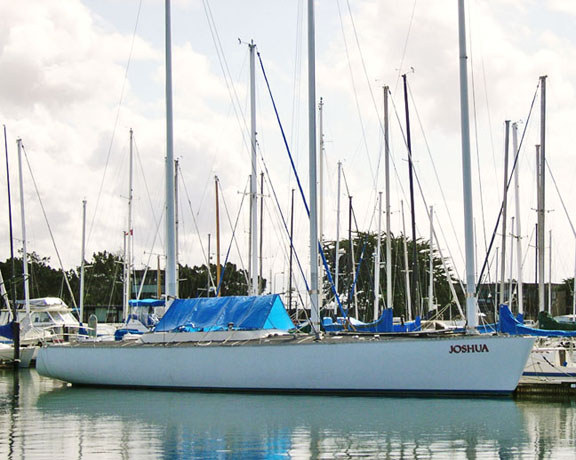
Fast forward to about 2010. I had moved to St. Augustine, FL, in 2003 and continued my yacht design practice there. I was approached by two different people who were interested in buying KL-II, now named JOSHUA and residing in the harbor in Berkeley, California. One of those people succeeded in completing the purchase and he moved her down to Long Beach, CA, where a refit commenced.
That was the last I heard of her, now 15 years ago.
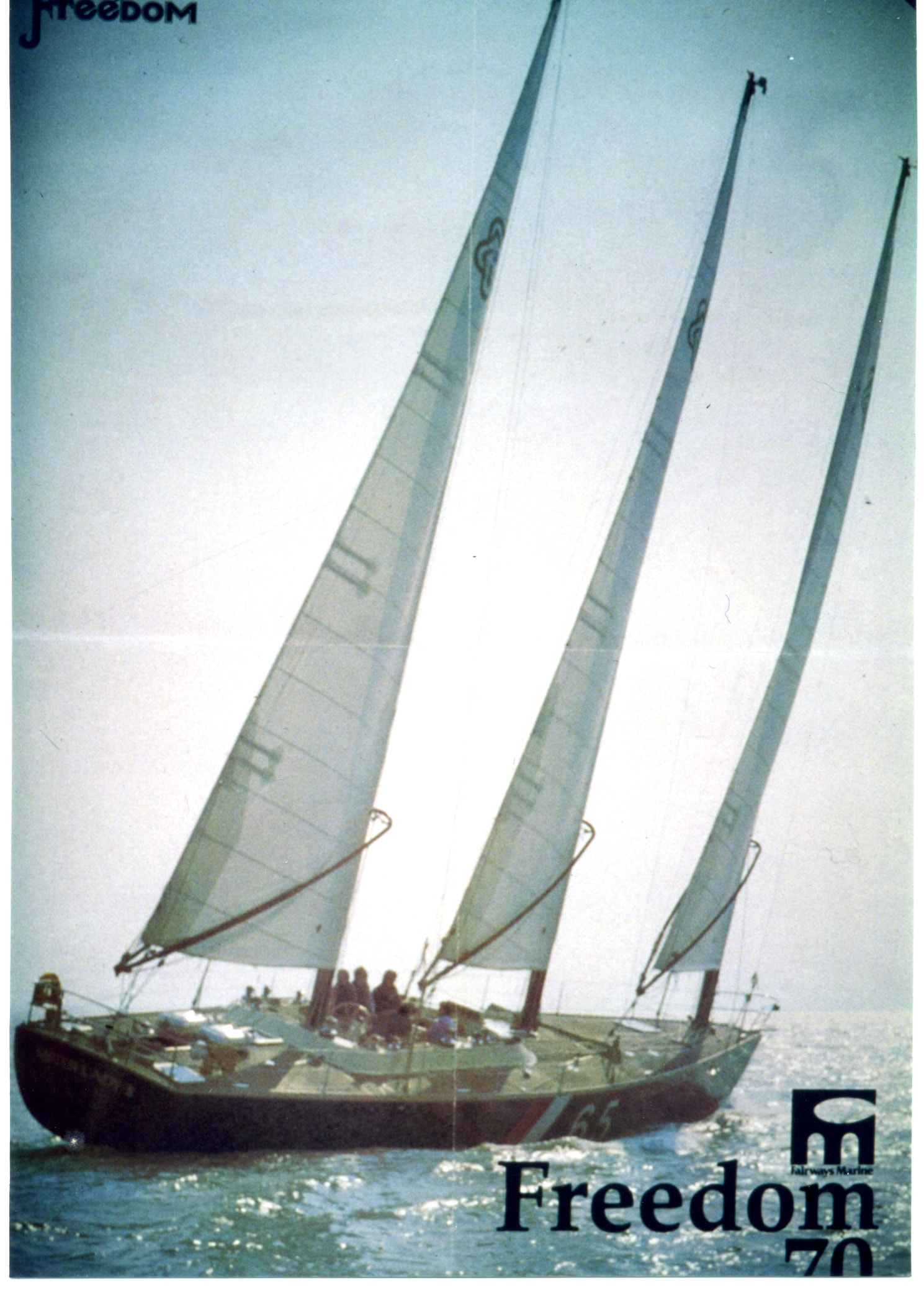
I attach two pictures of KL-II and Joshua. The picture of KL-II (Freedom 70) is from a publicity poster made by Celion carbon fibers (suppliers of the carbon fiber for the masts) that sat in my files for years until I moved to St. Augustine. Just before I moved, I was contacted by the son of one of the Fairways Marine employees who was looking for any news or mementos of KL-II. I gifted them the actual poster from my files.
The picture of Joshua was sent to me by one of the people who was interested in buying her in 2010. I have heard nothing since. She could still be in Long Beach for all I know.
That’s my 2 cents worth of knowlegde on the history of the one and only Freedom 70.
I hope that helps. Cheers,
Eric Sponberg
Eric,
This is Chris Samuelson (Goleen). I am sure we met. I was CEO of Fairways. I did the deal with Everett and Gary.
I was most interested to read what happened to KL. I would have bought her myself had I found her. I bought a Freedom 35 (you called it the 33) and later a 38 from Everett which I had shipped to Algeciras.
Naomi had a burst cyst on her ovary and was rushed to hospital in Plymouth. The pregnancy was much later. The Shoboshi Group caused the demise of Fairways. They failed to send us the agreed capital increase of £1 million. Later, I learnt the reason, the Saudi Government owed them some $4 billion and they ran out of cash. Arabs hate losing face. I resigned to force their hand.
Fairways funded the cost of making the Freedom 70 tooling and building Kriter Lady apart from the masts which TP provided. Kriter was Naomi’s sponsor. The deal with Kriter was Naomi and Laurel raced the Freedom 70 with us providing the 70 called KL for only the Two Star, not for the Whitbread.
Happy New Year!
Chris
Eric, the poster picture that you posted, I have too. We shot that one on the Solent. I have posted on here a close up of the crew sailing her that day. Anton Emmerton (Director of Fairways and in charge of sales, later co-founder of Fleming) on left, Rob James was on the helm, I am between Rob and Naomi, Thanos (Fairways in-house naval architect) and Geoff Houlgrave (Rob’s deputy on the Freedom 70). It was a sunny day with light breeze.
I guess that you and I are some of the few left from that time. I saw Everett’s obituary. Naomi lives near Cork in Ireland who I have been in contact with. Anton died suddenly of cancer. I have spoken with Ron Holland who is living in California. What news of Gary Hoyt?
I am writing a book at the moment in which the Freedom 70 features. I spent 7 years cruising on my Nordhavn 57 from 2003 until 2010 covering some 26,000 sea miles. Before buying my Nordhavn (she was a new build where the original buyer did not complete), I very nearly bought Voyager, a 70ft LOA ocean going heavy displacement boat from the founder of Nautor, the Swann builder in Finland. She had a range of 6,000 miles. He had been squeezed out of Nautor in a recession. I tried to find the Freedom 70 at that time too.
The boat building sector has always suffered in tough economic times.
Your 2 cents is a most valuable contribution. Thanks so much.
Chris
Hi Chris,
I stand corrected by your more intimate details of the Freedom 70 and Fairways Marine, thank you.
Garry Hoyt died about 9 months ago in Newport, RI. Here is an obituary from the Newport Daily News: Garry Hoyt Obituary - Newport Daily News . He paid me a great compliment by phone on the publication of my article “Project Amazon and the Unstayed Rig,” in Professional Boatbuilder magazine, Oct/Nov 1998, issue 55, Link from my website: https://ericwsponberg.com/wp-content/uploads/Project-Amazon-PBB.pdf.
Paul Dennis was the Freedom Yacht production manager at TPI in the 1970s-80s. He’s still around and owns Warren River Boatworks in Warren, RI, specializing in the care and feeding of Freedom Yachts.
One of the Freedom Yacht sales people was Mark Edwards, who for the last 15-20 years still sells yachts at East Coast Yacht Sales in S. Dartmouth, MA.
Paul Petronello ran Freedom Yachts for Everett Pearson, then bought Freedom Yachts outright and established a new facility in Middletown, RI. He closed down years ago but I have never had contact with him, so I don’t know where he is.
My first professional yacht design, Corroboree, was in 1984 for an American couple who were moving to Australia for a few years. They had Corroboree built in Auckland, New Zealand out of Kauri and Western Red Cedar in 1986/87, then shipped her back to the US where they sailed her on the Great Lakes for the next 27 years. My wife and I bought her back from them in 2014 and outfitted her for a circumnavigation. We left St. Augustine, FL, in January 2017 and about 32,000 miles later returned to Florida in June 2023. We now live in Alpharetta, GA, near our son’s family of two grandchildren in Atlanta. We have posted a video on YouTube about a day in the life at sea on Corroboree, link: https://www.youtube.com/watch?v=VZX7pU3Oqlw.
I retired exactly 10 years ago as of yesterday, 31 Dec 2015.
I hope that is all of some interest.
Cheers,
Eric
you guys are making me cry. I remember seeing a picture of Kriter Lady back when we had our Freedom 40 CK, and I thought my god that thing looks like a beast. I wish it had more press.
Also Eric, your project Amazon - geebus what a boat. I’m terribly sorry it ended the way it did, I think you are correct that it would have had a lot of success if properly funded.
Lance, most of the press was generated in Europe so in the US you had little. That would have changed had the Freedom 70 gone in the Whitbread as planned. My strategy to get the unusual looking Freedoms accepted in, what then, was a conservative sailing market, was to be in the news competing with conventional boats. The biggest race of all garnering the most publicity globally was the Whitbread. When a Swan 65 built by Nautor won the Whitbread, the demand for Swans took off.
The secret of why most of the first generation of Freedoms outperformed conventional sailing boats was the wrap around sails (controlled by wishbone booms). We ran tests on the efficiency of the Freedom mainsails compared to mainsails on tracks up the back of a mast. The Freedom wrap around mainsail was 96-97% efficient compared to the conventional mainsail at 60%. I was taught to fly in my teens and learnt about the aerodynamics of the wings of planes.
Gary told me what inspired him to build the first Freedom 40. He was overtaken in his larger cruiser racer where he needed crew in the Caribbean by a local boat with a cat ketch rig. He commissioned a simple 40ft hull with lifting centre plate, chose a large centre cockpit with aft cabin for himself and girlfriend, and used two aluminium lighting poles for masts with wrap around sails and wishbone booms. I expect your Freedom 40 had the wrap around sails with carbon masts (at least I hope so) enabling you to shape the sail according to the wind.
I let a Freedom 40 persuade Rob and Naomi James to head our ocean racing plans. Naomi was big publicity in England (and other countries) whereas Rob was almost unknown to the general public in the UK and lauded in France where ocean sailing is front page news. Naomi had been opening a supermarket in Southampton accompanies by Rob and came afterwards to meet me and see a Freedom 40. Rob was intrigued and Naomi thought the centre cockpit 40 was not suitable and was reluctant to even come for a sail. I told them that we planned a much larger Freedom for ocean racing. They were not dressed to sail so came back a few days later. It was a sunny day with 15-20 knots of wind. Fairways was based at Port Hamble marina on the Hamble River where there are some 8,000 boats berthed at 6 marinas.
John Richardson, sales manager for Freedoms, and I took Rob and Naomi out. We motored to the entrance of the river off Southampton Water and the Solent (the sea between the mainland and the Isle of Wight, the centre of sailing in England). Out of Hamble Point Marina at the entrance of the Hamble came a new Swan 42 designed by New Zealander Ron Holland who was based near Cork in Ireland where Rob and Naomi had a cottage. They James’s and Hollands were great friends and Ron was regarded as one of the top yacht designers. Perfect! I could not suppress the smile on my face. The Swan was on a demo sail and started to hoist sail. Rob wanted was so pleased to be able to measure the Freedom 40 against the Swan and wanted to hoist sail too but I asked him to be patient. “Let the mouse run”, I told Rob and Naomi, “we will have more fun.” Rob said that Swan 42 was very fast. I replied be patient. We gave the Swan a mile start and then I told Rob to hoist our sails. The Swan was doing 8 knots on a reach. I watched Rob’s face as the Freedom accelerated and was soon reaching at 10-12 knots. He jumped on the foredeck to hold the wishbone boom and told Naomi to do the same on the aft sail. “It’s two big windsurfer sails”, he told Naomi. We hauled in the Swan soon enough. The sales manager of Nautor was a friend of all of us and tried to get his potential buyers to look away. We passed the Swan, sailed around it, want back and passed it on the dirty wind side.
I suggested to Rob and Naomi that we should sail back to Port Hamble and I would show him the plans of a three masted Freedom that we would build for him to race in the Whitbread and, if Naomi’s sponsor Kriter agreed, she could race with Laurel Holland in the Two-Handed race from Plymouth England to Newport, Rhode Island known as the Two-Star. Back in the office, we were joined by Anton Emmerton, who headed sales and marketing, and Thanos, our in-house architect. The phone rang and it was the manager of Nautor UK to ask if his demo sail clients could come to see the Freedom, he said that he would send them if we promised to warn him when we were taking anyone else for a sail so he could avoid going out at the same time.
Because of the Freedom 3 masted self tacking rig with all running rigging led back to the cockpit aft of the middle mast, Rob estimated that we only needed a crew of 8 for the Whitbread and we designed the layout so the whole crew were in the aft end of the boat. Most other competitors would have crews of 12-14, so saving weight of people and stores. Gary had innovated with what we called a gun mount ahead of the foremast, essentially a T piece into which a carbon fibre pole would slot so the 70 could fly a spinnaker downwind which could be hoisted and then filled by using the guidelines at each end of the pole. In the Southern oceans it would be a powerful additional sail. We also had stay sails to fly from the central and mizzen masts.
Building the mould tools took the longest time. We built the actual 70 in 6 weeks and launched her just after the London Boat Show of January 1981. Rob and Naomi lived at my house at the entrance of the Port Hamble marina and he was hands-on as the Freedom 70 was created. The first sail had some 40 people on board. Down below we had boat craftsmen banging away to finish the interior while we sailed to Cowes on the Isle of Wight and back, most of the others were journalists and the Whitbread crew.
The 70 was an incredible boat. Naomi and Lauren had to sail 600 miles to qualify for the Two Star and simply sailed west along the coast of England to Cork and back again. They were purring on their return. Admiral Charlie Williams, head of the Whitbread Race, and I played a game with the media. Other competitors were kicking up a fuss about the 70 being allowed to compete. We put out stories of their objections and the negotiations. Charlie and I had agreed that Whitbread would have two prizes one for conventional sailing boats and one for all the competitors. We had agreed daily bulletins from on board using a dish to provide live pictures during the race. By the time of the Southampton to Cherbourg Race, the handicapper gave the 70 a handicap that had the 70 been a conventional boat required a 235ft high mast to carry the sail area. We loved it. We won the race by over 5 hours on actual time all the same. We had the prefect wind, Force 7 from the Needles at the western end of the Isle of Wight to Cherbourg, one reef in each of the three mainsails, making 16-20 knots the whole way.
The Two-Star proved a disappointment. First, Naomi had to be rushed to hospital two days before the race with a burst cyst in the ovary so we had to replace her. Rob was racing on a small trimaran, a commitment that he had before he had signed up with Fairways. In the end John Oakley agreed to sail with Lauren. As Eric has already explained, they had an issue with the bottom the centre mast and chose to drop out to make repairs but did finish. When the issue arose, the 70 was the leading monohull. Rob had had the Whitbread crew come to Newport to sail the 70 back and arranged a private race with Conny, the owner and skipper of Flyer, from Nantucket lighthouse to Lands End. The Freedom 70 set the second fastest time crossing the Atlantic beating Flyer by circa 4 days. The fastest time was set by the much larger America.
All of us involved with the Freedom project were convinced that the Freedom 70 would have won the Whitbread with ease and the publicity would have been huge with the result that we would have sold many Freedoms and the rig would have been copied by other boat builders.
I resigned trying to force our parent company to send Fairways the promised £1 million capital increase. That had no impact, I tried to buy the Freedom business and on the day before the Whitbread got a positive response. By then, it was too late. So near and yet so far. Without me at the helm and Fairways in administration, the second generation Freedoms designed in the US by Gary Mull went away from the wrap around sails. In the UK the Freedom 39 pilothouse schooner designed by Ron Holland that I had commissioned was built by the West Country yard that also built the Freedom 35 after the demise of Fairways. They also built the 39 in the US, a pilothouse and a normal version.
It could have so easily ended differently.
Chris.
thank you for the history lesson, it’s really impressive.
by the time I bought my 1980 Freedom 40 AC, the masts had been converted to sail track and conventional booms, but the performance was still very good. I remember once cruising in Maine with another boat that was “showing us where to go.” I had to deliberately oversheet my sails to sail slow enough to keep him, in a larger boat, in front of us (I didn’t want to embarrass him by luffing the sails so I kept them full). Were there any runners to help stabilize the spinnaker loads, or was the feeling that the masts were robust enough to handle having a kite up?
Chris, that’s a wonderful story, thank you.
Lance, thank you for your compliments on my open class 60 design Project Amazon. In addition to the Professional Boatbuilder article that I mentioned above, I published a technical paper in Marine Technology, Vol. 37, No. 2, Spring 2000, the quarterly publication of the Society of Naval Architects and Marine Engineers, which people can download here, Link: https://ericwsponberg.com/wp-content/uploads/Project-Amazon-SNAME.pdf. This paper discusses all of the salient design and construction features of Project Amazon in addition to her rig. When I retired 10 years ago, I donated all of Project Amazon’s design drawings to The Landing School, an accredited trade school for boat designers, builders, and systems technicians, with which I had had a long association. Design students use them as reference drawings for their classwork design projects.
Cheers, Eric
There were mobile back stays on all three masts. We just clipped them on to the toe rail.
Eric, did you also work with Tony Lush on Lady Peperell? (Another boat that could have helped persuade the masses about the virtues of unstayed masts.)
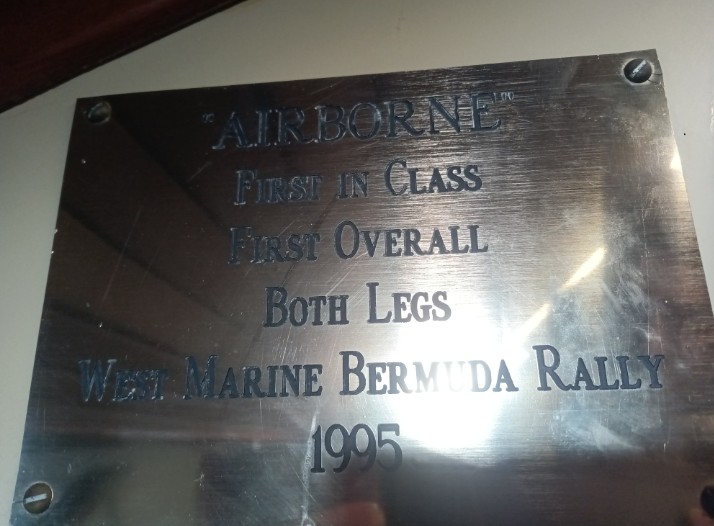
I noticed in the artikel the 44ft freedom winning sailing yacht, pag3 down on the page.
I have this in my boat. Is it the same? Or did they perform in different races?
Greetings from NL
Eric,
I have to tell you an amusing story at the London Boat Show of January 1981. Fairways had three Freedoms (40, 35 and 30 - 35=33 and 30=28), two Fishers (37 and 34, I think). We had stairway leading up to view the boats at deck level with meeting rooms and model of the Freedom 70 underneath, reception at the bottom of the stairs. The boat show was then held at Earls Court. We controlled access to the boats and would-be viewers could book times. We never had more than one party viewing inside at a time. The show lasts about two weeks and by the second week as the closing time approached our staff would be tired.
I was sitting down below on the Freedom 40 with Rob and Naomi James, John Oakley and Anton Emmerton when this gentleman comes down the companionway dressed in blazer and precisely creased trousers, white shirt, yachting club tie knotted tightly, and ask Rob James a farcical question. Rob replies politely disagreeing with the gentleman who snaps back “what do you know about sailing, you are just a salesman.” Before Rob could reply, I stood up and held out my hand to the gentleman (about 60 years of age). “Actually, not, I am the Managing Director of Fairways Marine”, I informed him. “May I make some introductions. Indicating Rob, I said “This is Rob James, winner of the Whitbread Round the World Race on GB II, winner of the two-handed transatlantic race with Chay Blyth, winner of the Round Britain & Ireland Race, also with Chay Blyth.” Now I indicated Naomi, “and this is Rob’s wife, Dame Naomi James, the first woman to sail solo around the world.” Now pointing to John Oakley, “this is John Oakley, Olympic gold medalist, skipper of America’s Cup challenger, Lionheart, owner of Miller & Whitworth which makes the sails for all Freedoms and Fishers built by Fairways Marine, winner of the Round the Island (Wight) race on a Freedom 35 who also won every race except one in last year’s Solent series on a Freedom 35. And this is Anton Emmerton, director of Fairways Marine in charge of marketing and sales.”. The gentleman gulped, stuttered, and fled up the companionway. Rob commented that we probably lost that sale. I laughed and said that I doubted he was ever a buyer and probably was berthed at the bar of his yacht club holding forth on his knowledge and exploits.
John Oakley had another viewer admiring the unstayed rig of the Freedoms who asked John how we kept the mast up without rigging. John could not resist. “We have a special glue developed by UHU with which we bond the mast to the deck.” The viewer asked if he could buy that glue to used on his boat so he could glue the mast to the deck and get rid of his stays. I was standing next to the two of them and butted in with an introduction to John who hastily told our viewer that he was pulling his leg and the masts were stepped to the bottom of the boat.
I used to tell people who marvelled at the unstayed masts that the Freedom was the monoplane of sailing yachts to the conventional biplanes with their tension system, one failure in their tension system could dismast the conventional biplanes. I would also ask them to look out of the window at the wings of their passenger jet on their next flight and see how the wings flexed over the bumps of the tarmac on their way to takeoff and had engines hanging off the wings. I would add that unstayed masts stepped to the bottom of the vessel had been the norm for centuries of sail.
Chris
Chris, since you bring up Chay Blythe’s name, do you know the status of the original British Steel? My parents owned her in the 90’s and I put a lot of miles on her with them when I was a teenager.
I am sorry but I haven’t followed what happened to the original British Steel.
Chris
Great story, Chris, thank you. I have used the airplane wings example in my own writings and talks many times. You might enjoy the article I wrote for my website called “Free-standing Masts–Some Thoughts on the State o the Art.” Link: https://ericwsponberg.com/wp-content/uploads/state-of-the-art-on-free-standing-masts.pdf. I describe the possible evolution of rigs from the time of the apes to the present day.
Cheers, Eric
Eben, according to a search through Google, as of August 2025, British Steel is in Devon, England undergoing restoration and is available for sale. Link: https://www.facebook.com/groups/brixhamandsouthdevon/posts/1718143368863775/.
Eric
Oh dear.. thanks eric ! I am happy to see her but seeing her in that state fills me with little bit of sadness.
I hope someone comes along and rescues her.
A fascinating thread! I have one of the Freedom 35’s built in Cornwall, and find her a very comfortable cruiser, easily handled by my wife and myself, though becoming a little heavy now we are well into our 70s. The sail handling is easy, and we, too, enjoy telling passers-by that it’s just a giant , two handed, windsurfer. We tug on the topping lift to demonstrate the flexibility of the masts, and extol the virtues of the simple reefing. In marinas, people gather to hear the rig explained. “Castaway” is also a very sea kindly boat, though we have rarely made any crossing further than to Norway, en route to the Baltic, where we usually spend a month aboard.
The previous owner of “Castaway”, the late George Tinley, won the Yachting Monthly Triangle race outright the year she was commissioned, and was class winner in a later year. He also raced with success in the Mount Gay Rum Challenge to Barbados, one of at least three transatlantic crossings she made, to participate in Antigua Week. He also cruised extensively to the Canaries, Madeira and the Azores.
We have never raced seriously, but the day after returning from a month in Sweden, we took part in a local club race with the boat still in cruising trim, all gear and dinghy aboard. Late starting, we went twenty miles around Mousa and back, passing all but one of the other, well crewed and race prepared, boats. It was pleasant to raise a coffee cup as the two of us lunched in the cockpit, whilst overtaking our friends, struggling with their spinnakers!
We first saw Freedoms when two took part in the Round Britain and Ireland Races, in the ‘70s and’80s, and were both intrigued and impressed by their layout and performance. During one race, we were privileged to entertain Rob and Naomi James as house guests during the 48 hour stop-over; “Colt Cars GB” had a rather spartan interior! They were such a pleasant couple, and seemed greatly to enjoy the company in Lerwick Boating Club. We had no idea that they had been so closely involved with Freedom yachts, and such vessels were beyond our wildest dreams at the time. Helping to repair a broken sail batten from their trimaran, we found it to be much longer than the Drascombe Cruiser we had then!
Recruiting a couple of friends to make a late season return from Goteborg to Lerwick, one was sufficiently impressed by “Castaway” and her handling at sea in strong winds, that he bought one himself, ‘Mo Saorsa”, which had been completed by Fairways Marine, and which he has refitted to a high standard.
Occasionally I regret not having bought a Freedom 40 when I had the chance, but really that would have been too large for the cruising we love in the Archipelagos of Sweden and Finland, and that boat had already been converted to battened sails on sailtracks, negating much of the advantage of the Freedom rig off the wind.
We are hoping now to see “Castaway” continue her adventures with a younger and fitter crew, but sad to think that Hoyt’s concept might be disappearing. Perhaps enthusiasm can still be found for something other than Bermudian rig?
I was very pleased to read about Castaway and your sailing experiences with her. I have heard similar stories from other Freedom 35 owners. Having returned to the financial world, I bought my first personally owned Freedom 35 in 1985, black hulled and built by Fairways, she was lying at Largs Marina near Glasgow. I was living in Spain at Sotogrande across the border from Gibraltar and building a house in the countryside while running a growing business. I didn’t have time to sail her the 1,000 miles so I got a delivery skipper to bring her with one crew. He had never sailed a Freedom before so I explained the rig and 35 over the phone. He averaged 8.6 knots to Puerto Duquesa and said she was the best sailing boat be had ever sailed. To average 8.6 knots for over 1,000 miles on a 33ft LOA boat is quite a performance.
Anton Emmerton, fellow director of Fairways, sailed a 35 from Salcombe to the Hamble alone and averaged 9.2 knots. He was very experienced and said it was the best sailing experience of his life. Anton had been sales director of American Marin (Grand Banks builder) before Fairways and later co-founded Fleming with Tony Fleming, who had Ben in charge of engineering at American Marine. Anton was a keen flyer and built his own kit planes. The success of Fleming enabled him to buy a single engined Beech. My last meeting with him included flying from Newport Beach for Catalina island. Cancer claims his life suddenly bur he always remembered the Freedoms and that passage.
Chris